Quite incredibly, a good proportion of the UK’s electricity is now produced from renewable sources (like wind farms and solar panels). What is even more amazing is that at any time of the night or day you can actually see how much of the National Grid’s electricity comes from all these energy sources (and the UK’s consumption thereof) by clicking on www.gridwatch.co.uk and selecting the tab marked ‘Meters’ just below the title.
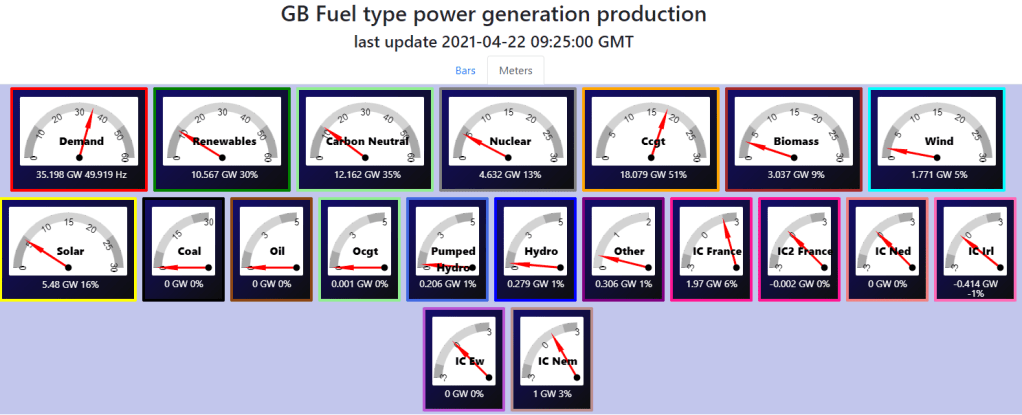
Note too that we also buy and sell spare electricity from / to our neighbours in France, the Netherlands, Ireland and Belgium. France in particular has nearly double the UK’s electricity generation capacity (574 TWh vs 334 TWh, albeit theirs comes mainly from nuclear power) which is handy when the wind isn’t blowing at 2am and your Nissan Leaf needs to get it’s charge from somewhere.
However, it is grid capacity that is the major limiting factor we have here in the UK about sharing electricity around the country. Simply building more solar farms or wind turbines is of no benefit unless you can move that electricity down some power cables (which all have a finite capacity limit before they melt) and onto the end consumer. For example, if we all converted our cars to electric-only (and changed nothing else), then the grid as it stands would not cope with all the extra charging demand, if we all used it at the same time. This gives us four options, I think:
- Spread the demand via off-peak/on-peak tariffs.
- Build more grid infrastructure.
- Generate more energy locally.
- Store more energy locally.
Option 1 is basically rationing and is perhaps the simplest and cheapest to implement. However, this is only delaying the inevitable demand problems, as the population increases and transport shifts away from fossil fuels. Option 2 is both costly and takes time to achieve, and it is difficult to plan priorities of where to invest first – Birmingham? Hull? Swansea?. This is where private companies struggle, as can be seen in the USA where infrastructure often fails because there is no financial incentive to upgrade it, and the grid itself is vulnerable to extreme weather events. Options 3 and 4 are more promising: local generation via solar panels, wind turbines, heat pumps, etc give better flexibility about energy storage and usage. Local storage of energy is still in its infancy, but it is improving, especially with battery technology, with companies like Powervault, Kaluza and of course the famous Tesla Powerwall providing local off-grid storage.
What should we as homeowners do about all this? My advice is to start by looking at reducing your energy dependencies in the future. Imagine there is a power cut (not uncommon in stormy weather in Wiltshire) – what are your back up options? A torch or candle will be fine for lighting, at least temporarily. Central heating doesn’t work without electricity supply, so sitting around an open fireplace** is your best bet, but it isn’t sustainable long term. Maybe we all need to look at becoming more resilient, by both generating and storing our own energy, just like the hunter-gatherers did when they collected wood for winter back in Stone Age times.
** I note that legislation has been introduced earlier this year to ban the sale of various wood and coal products in domestic fireplaces. I see the logic of the policy in improving the nation’s health, and perhaps it is a spur to consider our future energy sources sooner rather than later.
 Talking Electrical Ltd