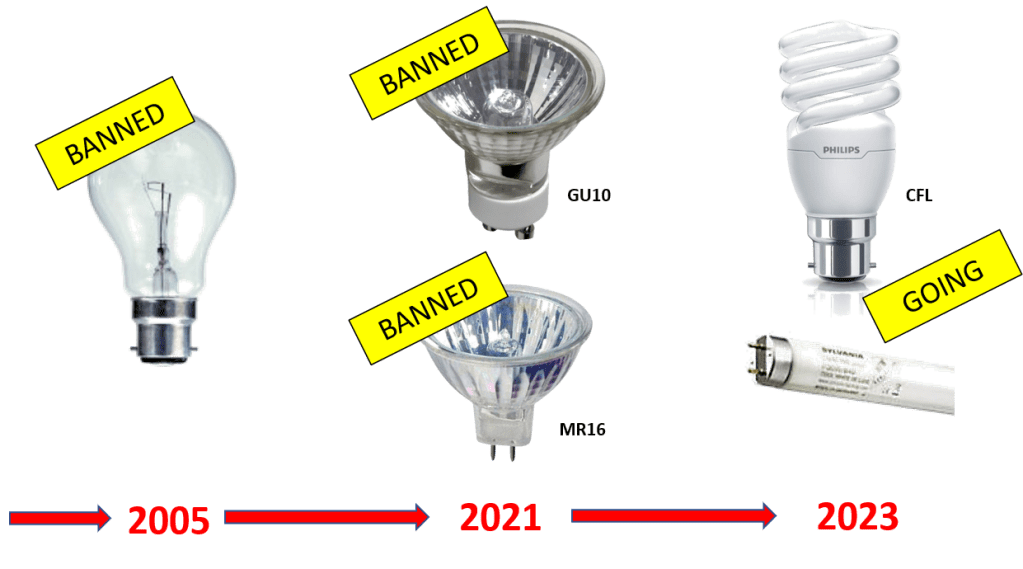
The UK government recently announced that the sale of halogen light bulbs will cease after September 2021 and fluorescent lights (i.e. strip light tubes and CFL bulbs) sometime in 2023. This had already been planned for several years right across Europe, to allow countries to reduce their overall energy demand. This change follows on from the 2005 ban of incandescent (or filament) bulbs which caused howls of protest from the public at the time (incandescent rage, perhaps?). What is the impact to today’s average consumer though?
The biggest use of halogen bulbs (along with overhead projectors) was the 1990’s fashion to install them in downlighters in just about everyone’s kitchens and bathrooms. Despite their many faults (roastingly hot bulbs, vulnerability to handling damage and the occasional explosion of glass everywhere) they remain very popular. The halogen light fittings were often flush or recessed in the ceiling, which is handy if a) you have low ceilings, or b) you are tall enough to bang your head against common pendant lights or c) you badly need to keep up with the Llewelyn-Bowens. I was never a fan of these lights (neither are the Fire Brigade) having seen far too many poorly-lit kitchens with an odd dangling, burnt-out carcass of a bulb holder somewhat spoiling the overall effect.
In terms of impact, the only real issue for consumers today is where an existing halogen bulb has to be replaced. For the common 240v GU10 bulb (see picture to work out which type you have), it should be straightforward to go out and buy an LED equivalent, though if you have dimmer switches, you need to choose dimmable LED bulbs, otherwise they will not work properly. For the various peculiar shapes like MR16 (and the smaller sized but otherwise identical MR11 & GU5.3, ) bulbs are more complicated, in that most (but not all) are 12V, and may need a separate driver installed (a device that balances the power into the LED) too. The myriad of options on replacement LED bulbs is also cause for confusion amongst customers and electricians alike. One supplier’s “Warm White” is another supplier’s “Cool White” or “Day White” or whatever. Let us hope all these bulbs will last a little while longer! If in any doubt, take your old duff bulb back to B&Q (or take a look online) and ask for help. [If some sales assistant tries to persuade you that you need to buy a whole new kitchen/bathroom instead, tell them to clear off and contact me instead.]
For me the interesting change is about fluorescent lights. Pretty much every factory, office and garage I have ever walked into has hundreds of these type of lights. Some business offices I know have only recently finished spending a whole lot of money converting these very same low-energy tube lights to high-frequency lighting units (so that the fluorescent lights don’t cause an annoying flicker when reflecting on computer screens). I suppose the bosses should have predicted fluorescent lights were always going to be phased out because of the impact on the environment of the mercury content inside the tubes. [Ironically, LEDs have traces of phosphorous content in them too, though the levels are trivial.] However, throwing out several hundreds of thousands of fluorescent tubes, transformers, tube holders, reflectors/diffusers and whatnot into landfill is going to cause a real environmental impact whatever anyone says, never mind the CO2 spent shipping replacement LED gear all the way from China to put up in its place. That said, LED lights do reduce our ongoing electricity demands, which will mean we should save some cash in the future, and (who knows?) maybe make the odd polar bear happy:

 Talking Electrical Ltd