
The ‘Lady of the Manor’ persuaded me to redecorate one of our bedrooms recently. The wall concerned had a couple of surface-mounted sockets in the plaster, so I took the opportunity to try out a new bit of electrical installation kit called Sockitz:
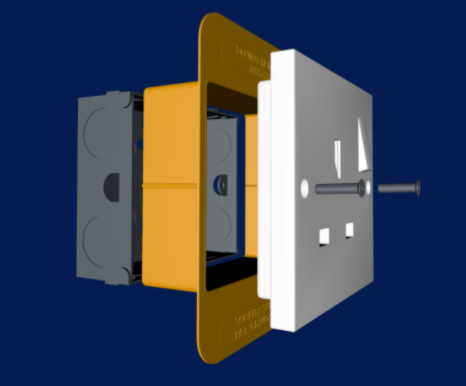
Invented by Richard Brook (who managed to get investment for these products from Dragon’s Den), Sockitz are insulated spacers that fit between an electrical socket and the backbox. This allows electricians to leave a socket (or switch) live and operational, while plasterers/decorators can plaster/tile/paint right up to the backbox without fear of coming into contact with live parts or having to remove the fascia.
So, why use them? Can’t tradespeople just work around the live sockets as they are? Er, no, not if the householder wants a neat-looking job, no paint/plaster/grouting on the fitting (and no electrocuted tradespeople on the floor). More importantly, using Sockitz adapters leaves the electrical installation safe so that the sparky can test all the electrics fully and leave them in an operational state. Without it, the electrician either has to come back to finish the wiring & testing (causing delays and extra costs), or both the householder / tradesperson have to work without an electrical supply in the meantime. A simple sandwich bag over the socket front will protect the switch/accessory from any paint / plaster / grout / water / etc, but still allows both the householder and/or other trades to use all the sockets as normal. The Sockitz adapter clips together to fit around the cables and is held in place with double-length screws. Once all decorating work is done, the Sockitz adapter is unclipped, removed and the normal-length screws used to refit the accessory. No electrical re-testing is necessary, so this can be left to any competent person with a screwdriver (provided they are not completely ham-fisted and turn the power off beforehand, of course).
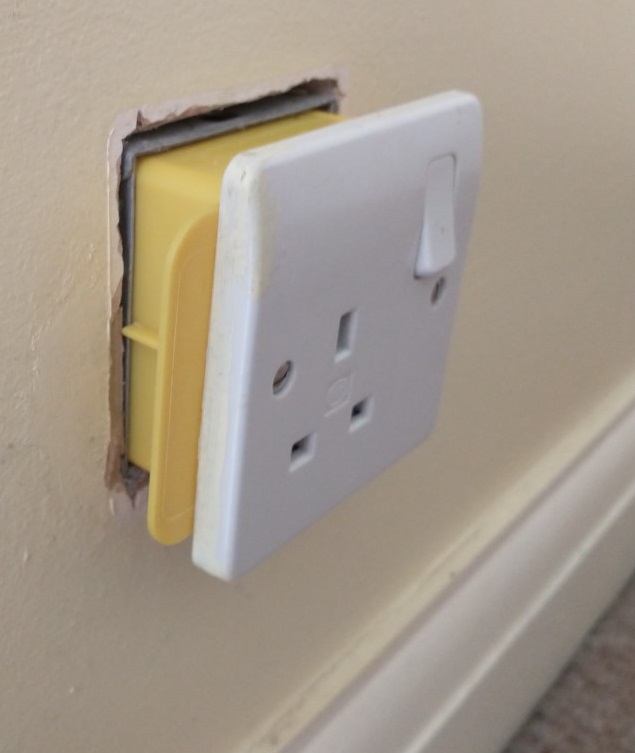
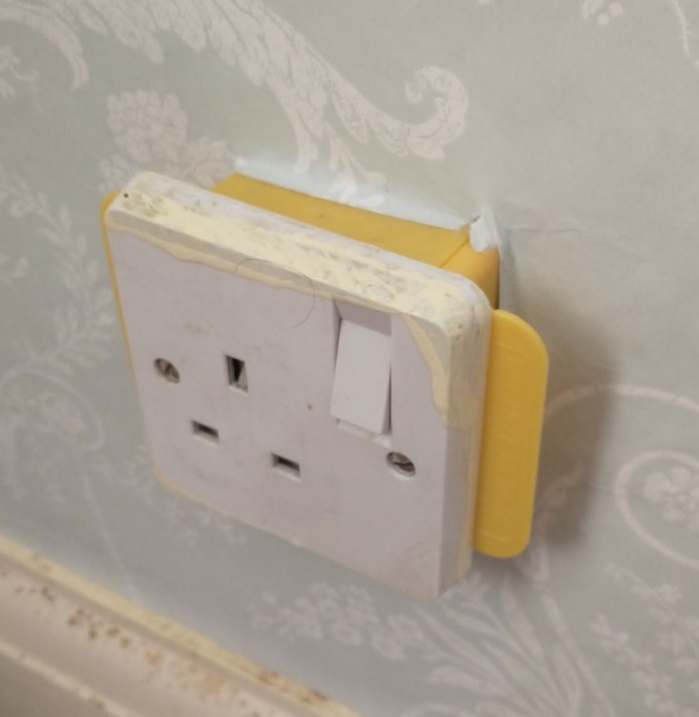
So what is my verdict? I really like them. The Sockitz I used are the re-usable ones (there are disposable versions too, for building sites), they are very easy to fit and come supplied with the extra-long (40mm) fitting screws. My only mistake was to fit them horizontally (as in the picture) whereas they should be fitted vertically**, especially when using them for wallpaper. The reason for fitting them vertically here is that you have to cut a slightly larger hole to allow the wallpaper to pass over the Sockitz adapter itself and it is easier to hide the larger cuts on the bottom of the switch than the sides.
Further uses of Sockitz
I also have one further bizarre use for these sockets: In a church hall building, I once checked out a nuisance trip, caused by the walls having lots of damp and being fitted with recessed sockets. The damp runs down the wall, behind the socket faces and shorts out the screwed contacts. The original solution was to wall mount all these sockets (which avoids the damp surfaces, rather like switches in sheds or garages) as a temporary fix (the building being due to be demolished, so little point spending on refurbishment). However, using the Sockitz allows me a much cheaper solution. By spacing all these sockets and switches from their original back boxes and away from the damp wall, this avoids any earth leakages or risk to users and allows easy testing of all the circuits. Safe, Secure and Simple strikes again!
** Fitting the Sockitz vertically also allows neighbouring accessories (e.g. a TV socket next to a 2 gang switch) to be fitted flush to each other.
 Talking Electrical Ltd