Most students have gone back to University or College around this time of year [written in October 2022] and lots of parents have ferried their offspring and their worldly goods off to some suitable student accommodation. Halls of residence are normally well maintained and have lots of industrial strength alarm systems and sprinklers. However, the student rental market normally has only basic protection. By law, ‘Houses with Multiple Occupancy’ (known as HMOs, e.g. student digs) need to have a working smoke alarm fitted on each occupied floor (and additionally a carbon monoxide detector if the property has any form of gas/oil/wood/etc heating, excepting gas cookers and hobs).
Ok, fine – the landlord has a duty to fit a smoke alarm, check it works when the tenancy starts and that’s it. If the alarm stops working or needs new batteries, the student/tenant has to let the landlord (or their agent) know. So far, so good. However, many landlords (and your average man-in-the-street) may not know that:
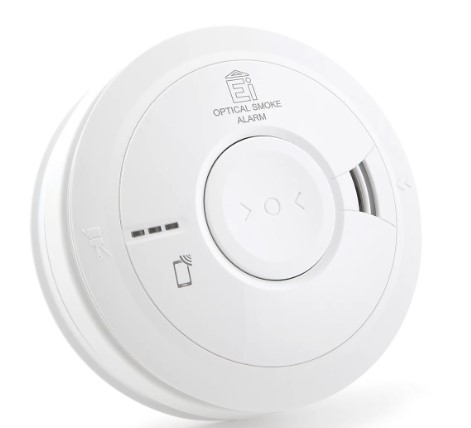
- There are three different main types of smoke alarms for various areas of the house (like kitchens, bedrooms and garages). No single type is suitable for all locations
- Smoke alarms don’t last forever and need replacing every few years (typically 5 – 10 years)
- Some alarms can be wired to the mains, so won’t need a regular battery replacement (but will still have a battery backup)
- Combined smoke alarm & carbon monoxide detectors are available, rather than having two separate devices
- If the alarm isn’t functioning, it might not be obvious – I have seen alarms with fully functional blinking LED lights that are as dead as a dodo. Pressing the Test button usually confirms things.
The cheapest, oldest and most basic smoke alarm is an ionization smoke alarm. To avoid confusing everyone with science, let me just simplify the explanation of how it works by just saying smoke particles interrupt the flow of charged particles in the air (think static electricity) which is then detected by an electronic box of tricks. Unfortunately, these types of smoke alarm have lots of issues:
- they contain a small amount of radioactive material, making disposal/recycling difficult,
- they only tend to detect raging, flaming fires, not smouldering ones (so they can be a bit late warning you)
- most of all they tend to raise false alarms when you cook in a kitchen/exit a steaming shower/drill into plasterboard/run a vacuum cleaner/etc, as the fumes/steam/dust/fleas/etc all have the same effect as smoke
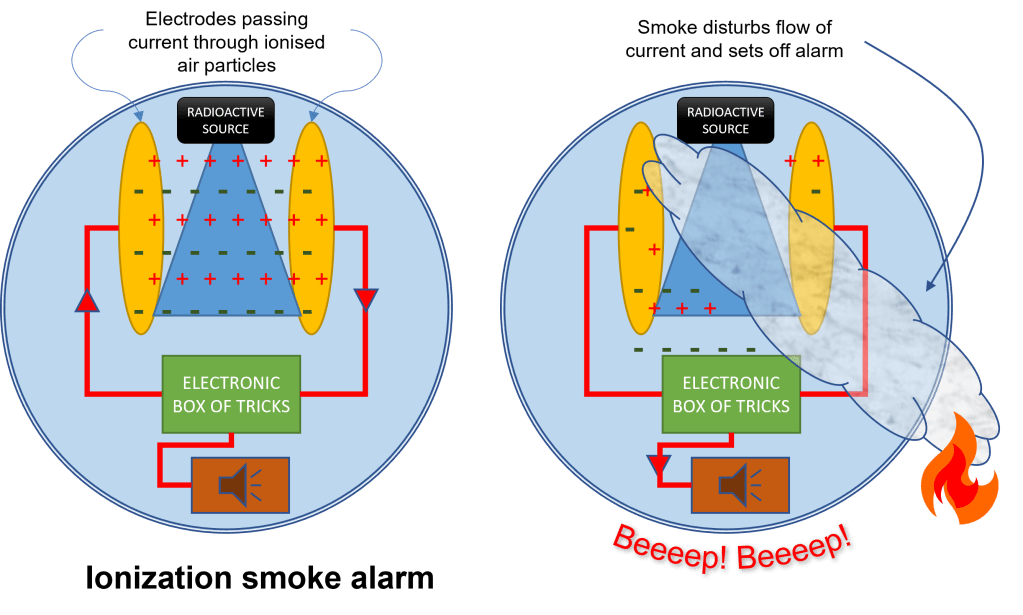
Ionization alarms can still be found in some properties (and are perfectly ok in, say garages and outbuildings) but since most of Europe have banned them (the UK hasn’t, but made it difficult to bin them), so most manufacturers have now decided they are no longer worth producing.
The ionization alarm has largely been superseded by the (more modern) optical smoke alarm. This operates on the principle of shining a beam of light at a mirror which reflects and spreads the beam more widely into a photocell. Smoke particles again disturb this weaker beam of light, which can be detected by the photocell, triggering an alarm. This makes the optical smoke alarm ideal for hallways, stairs, landings, escape routes and most general living areas. Often the alarm is combined with a carbon monoxide detector, which is an additional legal requirement where any item is used for heating or generating power (but not direct cooking/grilling) that operates with a naked flame (i.e. gas boilers, gas fireplaces, coal hearths, woodburning stoves, petrol generators, etc.) whether or not the appliance is actually used at all.
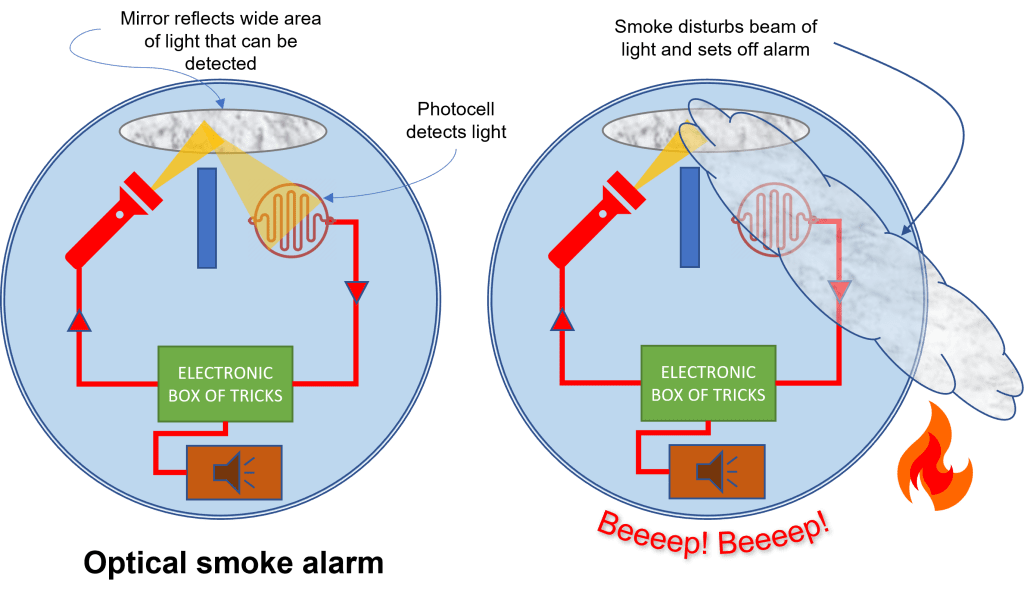
However, the optical smoke alarm still has the tendency to cause false alarms around kitchens, where there tends to be smoke particles from pretty much any form of cooking. Indeed, the very nature of cooking means that detection of smoke is not the key thing – far better to detect a real hazard, such as a chip pan fire or a toaster with a jammed bagel turning into a flaming appliance. Such calamities will cause a rise in temperature near the ceiling, which can be readily detected using a third type of device, the heat sensor alarm.
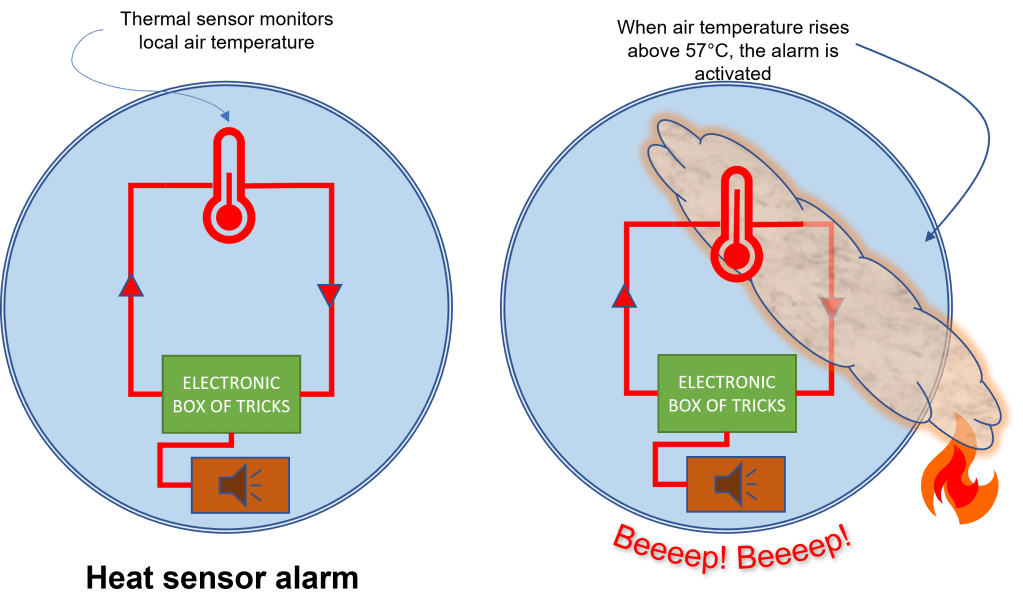
Despite seeing steam and general kitchen fumes, the heat sensor alarm will ignore all these false flags until it senses a particular temperature (usually 58°C) or a very rapid change in temperature. People tend not to sleep in their kitchens (one would hope) so asphyxiation by smoke inhalation is unlikely, but you could conceivably leave a pan on the stove or something under the grill whilst out of the room.
Latest developments of household smoke/fire alarms include being able to link them together, so if one goes off, they all go off. This is a nice idea, except any false alarms are going to be rather noisy, and in rented accommodation leads to people removing the batteries or covering the units to avoid conflicts with neighbours. Siting the alarms in proper places, away from walls/light fittings/air vents/heaters and so on will hopefully avoid such issues. Another problem (particularly for landlords) is the fact that batteries will slowly decay, leaving the alarms beeping a warning that they need replacing. Again, people tend to do the easiest option, which is simply remove the battery rather than replace it. However, many alarms can now be wired into a mains supply (usually a lighting circuit) and have the battery as backup in the event of supply failure. This extends battery life considerably, though the units will still warn if the battery has depleted beyond useful limits.
My final tip for householders and landlords: The Fire Brigade are experts in causes and prevention of fires at home. The London Fire Brigade have come up with a handy Home Fire Safety Checker that guides you through what you should consider to protect your property/yourself from danger and has advice about alarms. But above all, if you can’t remember when you last pressed the test button on your smoke alarms, go and do it now. And you and your loved ones can sleep safely.
 Talking Electrical Ltd