The UK government announced in March 2026 a plan to allow what are known as plug-in solar panels to go on sale, hopefully by the summer. A simple idea to plonk a solar panel on your fence / balcony / shed roof / etc. that is connected to an inverter (making solar DC into AC volts) which links to a plug that you stick into a nearby socket. Free electricity! However, fears have been raised by the UK electrician communities about potential safety hazards and a lack of standards around what is (and what isn’t) a plug-in solar panel. So, given that countries like Germany and France have been using these things for years (and every river barge I’ve ever seen has got at least two on board), what’s the problem? Can’t we all just buy all the bits from online retailers and wire it up ourselves, like people already do?
The issues can be summarised as follows:
- Permission from the landlord (for rented properties) or leaseholders (for tenanted properties) to fit removable panels (even though you wouldn’t ask permission to plug in your vacuum cleaner).
- Electrical product standards need creating around what are acceptable (and safe) as directly pluggable panels to use in the UK market (as opposed to allowing already EU-certified equipment).
- Amend building regulations so that ground mounted solar panels no longer need to be a minimum of 5m from a property boundary (an archaic building regulation intended only for stopping solar farms doing this).
- Automatic disconnection of the plug-in solar panel energy generation (in the event of a panel fault).
- Badly installed DC connectors (sometimes referred to as MC4 connectors) to/from the solar panels to the inverters. These can cause very serious fires long after installation, as the DC voltage creates a continuous arc (unlike your normal 240V AC supply).
- The electricity supplier (the District Network Operator or DNO) for the area needs to know that you could be generating power and exporting it back to the grid (note that the DNO is not the same as the energy company you pay your bills to – rather it is the people who manage the electricity grid in your area).
To be fair to everyone, the first three above are largely petty legal positions that might need some parliamentary time to draft the necessary legislation and get on with it. Also, if you have already got properly installed solar panels, then most of the above are already pretty much resolved. However, the next two issues are a bit more of a concern from an actual safety point of view (I’ll deal with the final one at the bottom of this page). Let’s take a look at the Automatic Disconnection first.
If your household sockets are protected by Residual Current Devices (an RCD, or alternatively a Residual Current circuit Breaker with Overcurrent protection or RCBO), then it is really important that they remain effective in the event of a fault. Assuming you have one fitted that is protecting your sockets, it needs to be:
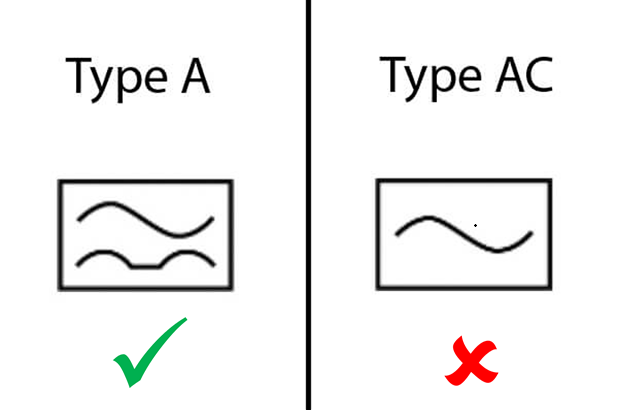
- Type A (not Type AC), indicated by the symbols shown here on the device
- Cuts the connection of both the Live AND Neutral when it trips, not just he Live
- Is a bi-directional type device (handles imported or exported power)
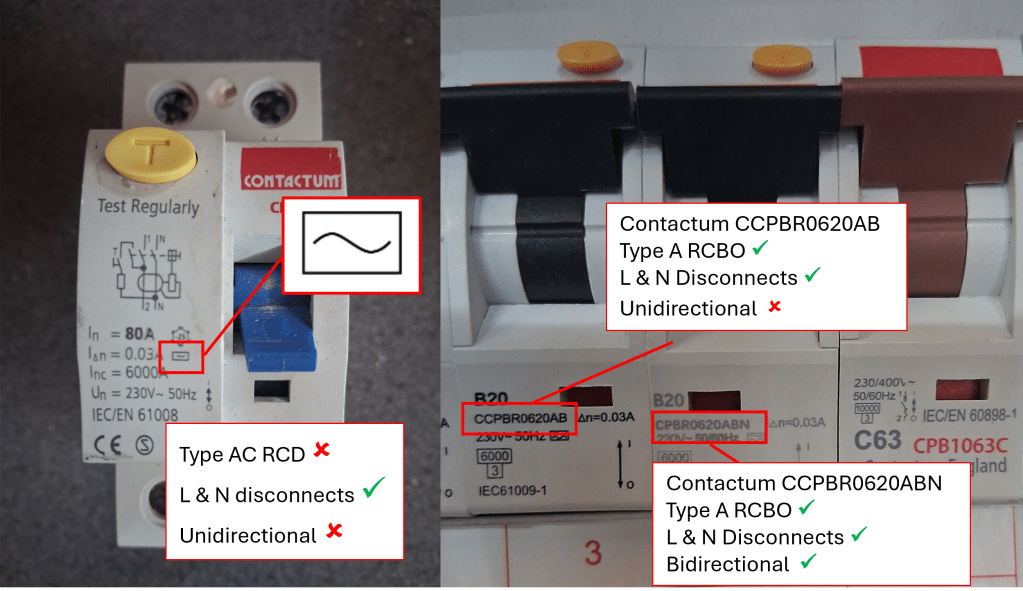
Because all these things aren’t easy to determine, the easiest way (assuming that you don’t employ an electrician to come and check!) is to make a note of the RCD’s/RCBO’s manufacturer and serial number, go onto their website and check the device specification. The bi-directional element needs to be clearly specified somewhere in the documentation – this is what will stop your RCD electrical internals possibly getting fried and not actually continuing to work in the event of some fault with your solar setup. I’ve shown some examples of what to look for below:
If you really can’t work it out or just haven’t got an RCD or RCBO, get an electrician in (I would say that, wouldn’t I?) to sort out your installation. If your electric installation is older than (roughly) 2008 and doesn’t even have an RCD protecting the sockets, then do yourself and your loved ones a favour and get them fitted (and tested!) properly by someone who knows what they’re doing first. Also, if you haven’t got an external socket to connect the inverter to your supply, then dangling the cable (or worse, an extension lead) through an open window or doorway is asking for trouble – its a trip hazard and/or potentially damaging to the cable. Remember, this cable will always be carrying current in daylight hours, so get a proper external socket fitted so you can enjoy free electricity, even when its raining. As an aside, if you disconnect the three pin plug leading from the inverter to your socket, the bare pins will no longer be live – the inverter detects if there is no mains supply and kills the power output immediately.
The next issue is the MC4 connectors used to link the cable between the solar panel and the inverter. [Note that if and when they allow balcony solar kits to be sold on the high street, they will almost certainly come pre-wired (like modern washing machines and fridge freezers) so this part won’t apply, but it is worth being aware of the cabling anyway]. If (like me) you plan to install your own solar panels, please, please use a proper standard crimp tool for fitting the cable connectors and ideally watch a video of how to fit them correctly. If you get this bit wrong, you really do risk burning down your house – fires under solar panel get really hot, really fast. Also, either buy proper solar cable that is intended for use outdoors (ordinary flex isn’t suitable for prolonged UV exposure) or buy pre-made cables. Also, secure the cables with cable ties or clips and flexible trunking so that they don’t flap about in the wind and allow your fence/wall/flat roof/tiles to wear away the cable insulation. Whatever you do, don’t try to disconnect the cables when the sun is on the panels when you have something using the solar generated power – you will create a very large and nasty DC arc that will cause you severe burns or start a fire!
The final thing is notifying the DNO (in Sussex, this is Scottish South Eastern at the time of writing). Why does the DNO need to know? Consider a typical street of houses which are supplied from a transformer:

In the above picture, energy only comes from the transformer. Because of cable resistance, house 8 will see slightly less than 240V whereas house 1 will see the maximum voltage. So the supply voltage has to be maintained within a specified range (currently 6% below or 10% higher maximum)*. This is why your mains supply voltage can be anything from 216V to 253V. The transformers are normally set to be in the upper range to allow for drops in voltage at peak times (e.g. teatime or during major TV events, etc). So far, so good. The problem comes when everyone on the street puts solar panels on their houses, but they don’t use (or store) the energy – that energy has to go somewhere. What happens in this case is that the voltage on the supply cable goes up (a bit like hydroelectric power – when water is pumped back uphill during off-peak times):

The DNOs need to manage that overvoltage (they’re more used to managing teatime voltage dips) but it is harder for them to do so if they don’t know who has got solar (or batteries that can feed back to the grid). Hence you or your installer need to fill in a request (known as a G98 form) which is a painless process, if a little bureaucratic. What happens if you don’t? Well, in the absolute worst case, the transformer can shut down to prevent potentially wrecking internal electronic equipment (TVs, laptops, boiler controls, etc) in houses 1 to 8. More likely is where any house that has an EV charger in use will find that the charger stops working and won’t reset, making it a bit difficult to use the car! Overvoltage also reduces the lifespan of electrical equipment and can cause nuisance trips in households. So, just let them know – it usually costs nothing except a bit of your time.
So, should you DIY (or buy) a balcony solar system? Absolutely! At the very least, you are getting free electricity to cover background low level continuous usage (fridge/freezer, modem/router, TV, central heating programmer, etc). The actual energy you will save from just balcony solar may be small (to see the costs and benefits, there are some good estimating tools here) but all those pennies add up over the years and the lifespan of this kit tends to be in years (if you buy decent inverters). So, what are you waiting for? Government regulations to be approved in Parliament? Get out there and put some solar PV in! [And please contact me if you don’t feel able to do it safely yourself, of course.]
* The DNOs are looking to get this changed to be 230V ±10%, so giving more wiggle room on the supply. For some reason this takes ages to get approval, whereas in Europe it has been the case for years without issue.

